How to Dress Smart Casual: A Practical Guide
Smart casual, decoded: what the dress code means, how to pair tailored and relaxed pieces, get the fit right and avoid the usual mistakes.
In this article
- The short answer
- Before you start: settle three things
- Build the outfit in this order
- Get the fit right before anything else
- The one-up, one-down rule in practice
- Shoes decide whether it works
- Colour and pattern without overthinking it
- Calibrate by where you're going
- What usually goes wrong — and the fix
- Dressing for British weather
- A sixty-second check before you leave
The short answer
Smart casual isn't a watered-down suit, and it isn't your weekend clothes with the collar turned up. It's a mix: one tailored or structured piece sitting next to one relaxed piece. A blazer over a plain T-shirt. A fine knit with tailored trousers. Dark jeans with a pressed shirt and leather shoes.
Aim one notch below business dress and one notch above what you'd wear to the pub on a Saturday. If nothing in the outfit has a bit of shape to it, you've gone too casual. If you could wear the same thing to a formal meeting with a tie added, you've gone too formal.
Fit and condition matter far more than price at this dress code. Clean shoes, a hem that sits properly and a shirt that isn't gaping at the buttons will do more than anything expensive that fits badly.
Before you start: settle three things
Don't open the wardrobe until you've answered these. Most smart casual failures are actually misread occasions, not bad clothes.
- The wording. "Smart casual" on a wedding invitation, in an office handbook and on a restaurant booking mean three different things. An office policy usually means no trainers and no logos; a wedding usually means suit separates without a tie.
- The room and the time. Evening, indoors and seated leans smarter. Daytime, outdoors and standing leans relaxed. Look at what the hosts or the senior people in the room are likely to wear and land just under that.
- What's actually ready. Ironed, clean, fits, shoes presentable. The outfit you can wear tonight beats the ideal one that's in a laundry basket.
Build the outfit in this order
Set the dial: how smart, how casual
Decide before you touch a hanger. Ask who the best-dressed person there is likely to be and aim just below them. Write it down as 'smart-leaning' or 'casual-leaning' — every other decision follows from it.
Choose your bottom half first
Trousers, a skirt or dark jeans set the tone, because they sit between the shoes and the top. Tailored trousers pull the whole outfit up; dark jeans keep it relaxed. Light-coloured or cropped trousers read more casual than dark ones.
Pick the top to answer it
Tailored trousers want a shirt, a fine knit or a plain heavier-weight T-shirt. Dark jeans want a shirt, a knit or a good plain tee. Keep the top plainer than the bottom if in doubt.
Add one structured layer
A blazer, a tailored jacket, a fine-gauge cardigan or an overshirt. One layer only — two competing layers is what makes outfits look confused and bulky.
Choose shoes that belong to both halves
The shoe has to make sense with the trousers and with the layer above. Leather shoes or loafers with tailored trousers; clean minimal trainers or boots with dark jeans. Match formality to the trouser, not to the jacket.
Edit in daylight, then take one thing off
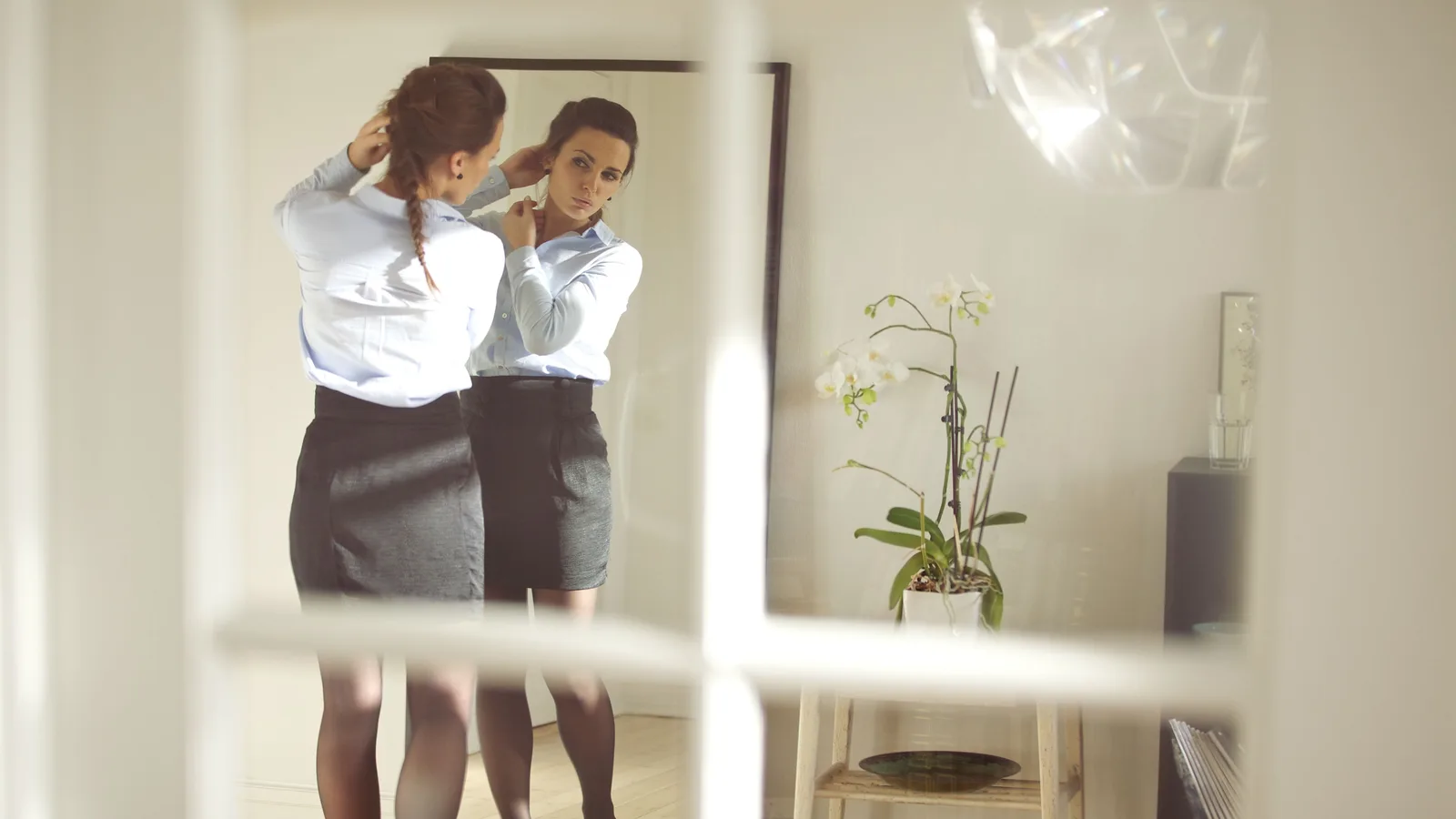
Check in a mirror near a window rather than a warm indoor light. Then remove the thing you're least sure about — a scarf, a second pattern, a chunky watch. Smart casual is usually improved by subtraction.
Get the fit right before anything else
At this dress code, fit is the whole game. Two fixes carry most of the weight: the trouser hem and the shoulder seam. Hems and waists can be altered cheaply; shoulders can't be altered usefully at all, so try jackets on over the layers you'll actually wear.
- Trouser hem
- Touches the top of the shoe with a slight break; nothing pooling over the laces or swinging above the ankle
- Jacket shoulder seam
- Ends at the edge of your shoulder — padding should not extend past the bone
- Sleeve length
- Jacket cuff ends at the wrist bone so roughly a centimetre of shirt cuff shows
- Shirt collar
- Sits flat at the back of the neck; you can slide one finger inside when buttoned
- Waistband
- Flat and comfortable when seated, with no gaping at the back
- Knit or T-shirt length
- Ends around mid-fly — long enough to tuck, short enough to wear loose without looking like a nightshirt
The one-up, one-down rule in practice
For every relaxed piece, match it with something with a bit of structure — and for every formal piece, loosen something else. This is the single most useful table to keep in mind.
How to move an everyday piece into smart casual territory
| Piece | Everyday version | Smart casual version |
|---|---|---|
| T-shirt | Printed, thin, or gym fabric | Plain, heavier-weight cotton in navy, white, grey or black, with a clean neckline |
| Jeans | Faded, ripped, baggy or ultra-skinny | Dark indigo or black, no fading or distressing, straight or slim |
| Trainers | Running shoes or chunky gym trainers | Clean, minimal, single-colour leather or canvas |
| Jumper | Hoodie or chunky cable knit | Fine merino or cotton knit, worn over a collared shirt |
| Shirt | Buttoned to the neck with a tie | Oxford or poplin, top button open, sleeves rolled to just below the elbow |
| Shorts | Sport or cargo shorts | Tailored, above the knee, in cotton or a linen blend — daytime only |
Shoes decide whether it works
People read the outfit from the feet up. Leather loafers, derby shoes, Chelsea boots, ballet flats, block-heel ankle boots and clean minimal trainers all sit comfortably inside smart casual. Sports trainers, hiking shoes, visibly scuffed toes and worn-down heels undo everything above the ankle.
Condition beats style: a plain pair that has been wiped, polished and re-laced looks smarter than an expensive pair with a scuffed toe. If you're wearing a heel, check it doesn't sink or wobble on the surface you'll be standing on.
Colour and pattern without overthinking it
- Two neutrals plus one accent. Navy, charcoal, stone, olive, white, black and mid-grey all sit together. Pick two, then add one colour if you want it.
- One pattern at a time. Checked jacket means plain shirt. Striped shirt means plain trousers.
- Contrast sets the mood. Dark trousers with a light top reads sharper; light trousers with a dark top reads more relaxed.
- Texture does the work in winter. Wool, flannel, corduroy and suede give interest without pattern.
- Keep logos out. Logos are what turn smart casual into gym casual.
Calibrate by where you're going
| Where you're going | Lean towards | What does the work |
|---|---|---|
| Office with a smart casual policy | Smarter | Tailored trousers or a skirt, a shirt or fine knit, leather shoes, no visible branding |
| Dinner or drinks | Either | Dark jeans or trousers, a fine knit or shirt, loafers or clean boots |
| Wedding where smart casual is stated | Smarter | Suit separates without a tie, polished closed shoes, no denim or trainers |
| Interview | Smarter | Blazer or jacket, plain shirt, tailored trousers, closed-toe shoes |
| Weekend or daytime social | Relaxed | Dark jeans, plain tee, overshirt, clean trainers |
What usually goes wrong — and the fix
| Symptom | Why it happens | The fix |
|---|---|---|
| You feel underdressed | Every piece is relaxed | Swap one item for structure: tailored trousers, leather shoes or a blazer. One is enough |
| You feel stiff and overdressed | Every piece is formal | Lose the tie, switch the shirt for a fine knit, or wear clean minimal trainers |
| It looks borrowed | Fit is off, not style | Hem the trousers, take in the waist, shorten the sleeves. Alterations beat new clothes |
| It looks flat | Everything is the same tone and texture | Add one contrast: a darker trouser, a knit over the shirt, a belt that reads against the fabric |
| It looks busy | Too many colours or patterns compete | Cut to two colours and one pattern, then keep the rest plain |
| You're uncomfortable all evening | The outfit only works standing still | Sit down, reach up and walk in it before you leave. Fidgeting shows |
Dressing for British weather
Layering solves most of it: shirt, then a fine knit, then a jacket or overshirt, then a coat you can take off indoors. Central heating makes removable layers more useful than heavy ones.
Cotton, linen and lighter knits for summer; merino, wool, flannel and corduroy for winter. Suede and unsealed leather are a gamble in the rain — if the forecast is wet, choose a shoe you can wipe down, and dry leather away from direct heat rather than on a radiator.
A sixty-second check before you leave
- Look at the full outfit in daylight, not just the top half in a bathroom mirror.
- Sit down, reach overhead and walk a few steps — check the waistband, the shirt hem and the sleeve length.
- Check the shoes from the front and the heel.
- Run a lint roller over dark trousers and knits.
- Take one accessory off.
Frequently asked questions
Can I wear jeans to a smart casual occasion?
Yes, if they're dark, unfaded, undamaged and well fitted to your leg. Pair them with a shirt or fine knit and leather shoes or clean minimal trainers. Ripped, heavily washed or very baggy jeans tip the outfit into casual whatever you wear on top.
Do I have to wear a jacket?
No. A jacket is the quickest way to lift an outfit, but a fine knit over a collared shirt, or a pressed shirt with tailored trousers, covers smart casual without one. If you do wear a jacket, keep everything underneath simpler.
Are trainers ever acceptable?
Clean, minimal, single-colour leather or canvas trainers usually are, especially with dark jeans or cropped tailored trousers. Running shoes, chunky gym trainers and visibly worn pairs read as casual no matter what they're paired with.
What does smart casual mean on a wedding invitation?
Treat it as suit separates without a tie: tailored trousers or a skirt, a jacket or a smart knit, and polished closed-toe shoes. Skip denim, trainers and T-shirts, and avoid anything you'd wear to the office on a normal Tuesday.
Should I wear a tie with smart casual?
Usually not — a tie pushes the outfit towards business dress. If you want one, keep the rest deliberately relaxed and skip the matching suit so it reads as a choice rather than a uniform.
Is smart casual different for men and women?
The principle is identical: put one tailored or structured piece next to one relaxed piece. Only the specific pieces change — a blazer and chinos on one person, a tailored skirt and fine knit on another.